November 16, 2014

How to Think Like Leonardo DaVinci

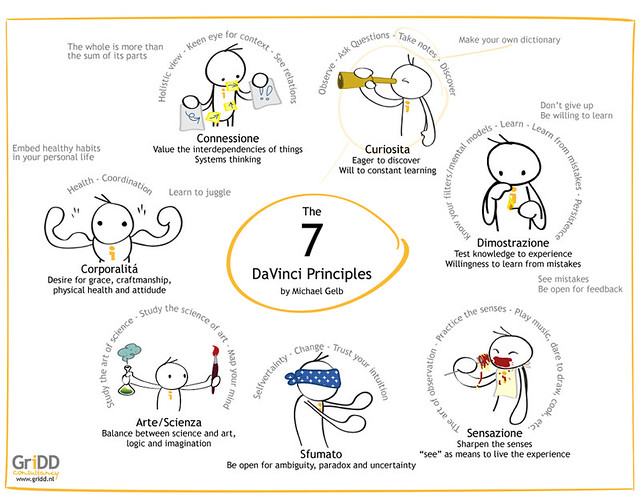
I have been glimpsing through this interesting book by Michael Gelb who studied Leonardo Davinci's writings and found 7 key principles behind what made Davinci the genius he was. Below is his list. 


Davinci's 7 Keys to Genius
  1. Curiosità: An insatiably curious approach to life and an unrelenting quest for continuous learning.
  2. Dimostrazione: A commitment to test knowledge through experience, persistence, and a willingness to learn from mistakes.
  3. Sensazione: The continual refinement of the senses, especially sight, as the means to enliven experience.
  4. Sfumato: A willingness to embrace ambiguity, paradox, and uncertainty.
  5. Arte/Scienza: The development of the balance between science and art, logic and imagination. “Whole-brain” thinking.
  6. Corporalitá: The cultivation of grace, ambidexterity, fitness, and poise.
  7. Connessione: A recognition of and appreciation for the interconnectedness of all things and phenomena. Systems thinking.

-------


*Which one of these seven habits can you work on this month???
Want to have ideas of how....try some of the self-assessments and activities from his book. The book has been outlined in an interactive online mind-map so you can find which you are interested in. Mind mapping is awesome! Click on the link above to try the mind map.

*Paul and I did the Curiosity 1st activity that is to jot down 100 questions that come to your mind as fast as you can. Then you go through them and find what common themes are. And narrow down your ten most important questions. IT was a fun activity.


------------
Here are the assessments from the book for each of the seven points.
Curiosita
ü  I keep a journal or notebook to record my insights and questions
ü  I take adequate time for contemplation and reflection
ü  I am always learning something new
ü  When I am faced with an important decision, I actively seek our different perspectives
ü  I am a voracious reader
ü  I learn from little children
ü  I am skilled at identifying and solving problems
ü  My friends would describe me as open-minded and curious
ü  When I hear or read a new word or phrase I look it up and make note of it
ü  I know a lot about other cultures and am always learning more
ü  I know or am involved in learning a language other than my native tongue
ü  I solicit feedback from my friends and relations and colleagues
ü  I love learning

Dimostrazione
ü  I am willing to acknowledge my mistakes
ü  My closest friends would agree that I am willing to acknowledge my mistakes
ü  I learn from my mistakes and rarely make the same one twice
ü  I question “conventional wisdom” and authority
ü  When a celebrity I admire endorses a product, I am more likely to buy it
ü  I can articulate my most fundamental beliefs and the reasons I hold them
ü  I have changed a deeply held belief because of practical experience
ü  I persevere in the face of obstacles
ü  I view adversity as an opportunity for growth
ü  I am sometimes susceptible to superstition
ü  In considering new ideas my friends say that I’m: a)gullible/”new-agey”, b) close-minded cynic, or c) open-minded skeptic

Sensazione
ü  I am sensitive to color harmonies and clashes
ü  I know the color of all my friends’ eyes
ü  I look out into the far horizon and up to the sky at least once a day
ü  I am good at describing a scene in detail
ü  I like doodling and drawing
ü  Friends would describe me as alert
ü  I am sensitive to subtle changes in lighting
ü  I can picture things clearly in my mind’s eye

Sfumato
ü  I am comfortable with ambiguity
ü  I am attuned to the rhythms of my intuition
ü  I thrive with change
ü  I see humor in everyday life
ü  I have a tendency to “jump to conclusions”
ü  I enjoy riddles, puzzles and puns
ü  I usually know when I’m feeling anxious
ü  I spend sufficient time on my own
ü  I trust my gut
ü  I can comfortably hold contradictory ideas in my mind
ü  I delight in paradox and am sensitive to irony
ü  I appreciate the importance of conflict in inspiring creativity

Arte/Scienza
ü  I like details
ü  I am almost always on time
ü  I am skilled at math
ü  I rely on logic
ü  I write clearly
ü  Friends describe me as very articulate
ü  Analysis is one of my strengths
ü  I am organized and disciplined
ü  I like lists
ü  I read a book starting at page one and go through in order

ü  I am highly imaginative
ü  I am good at brainstorming
ü  I often say or do the unexpected
ü  I love to doodle
ü  I am better at geometry than algebra
ü  I read a book by skipping around
ü  I prefer to look at the big picture ad leave details to someone else
ü  I often lose track of time
ü  I rely on intuition

Corporalita
ü  I am aerobically fit
ü  I am getting stronger
ü  My flexibility is improving
ü  I know when my body is tense or relaxed
ü  I am knowledgable about diet and nutrition
ü  Friends would describe me as graceful
ü  I am becoming more ambidextrous
ü  I am aware of the ways in which my physical astate affects my attitudes
ü  I have a good understanding of practical anatomy
ü  I am well coordinated
ü  I love to move

Connessione
ü  I am ecologically aware
ü  UI enjoy similies, analogies and metaphor
ü  I frequently make connections that others don’t see
ü  When I travel I am struck more by people’s similarities than their differences
ü  I seek a holistic approach to diet, health and healing
ü  I have a well-developed sense of proportion
ü  I can articulate the systems dynamics—the patterns, connections, and networks—in my family and workplace
ü  My life goals and priorities are formulated clearly and integrated with my values and sense of purpose
ü  I sometimes experience a sense of connectedness with all Creation


Celebrating Motherhood: My Blessing Way

Have you ever heard of a Blessing  Way? It's like a baby shower, but instead of just celebrating baby and getting baby gift stuff, this is more a celebration of motherhood and has a feel of traditions and respect. Apparently it has Native American roots and many other cultures and traditions mixed in. (who could resist a fun new experience merging lots of cultures...Not me!)

I'd heard about it from my friend Rachel, so I asked her to throw me a little one with a few close friends that like holistic and interesting new experiences. :) And it was so fun! I highly suggest it if you like that stuff.

I think that it's so easy to get caught up in preparations for baby and craziness, that it takes extra effort to remember that mom is important and the birthing experience is about the journey and feeling...not just the outcome.

So here's what we did....

We had candles lit and nice music playing and when we got there (I did it with another friend who's  due a month after me) Rachel put a laurel wreath on our heads with flowers. We chatted and ate healthier version treats and wassail. Everyone had found a favorite quote, saying, poem (Emily wrote a beautiful one I'll post at the end of this) about motherhood to share in their turn and express what motherhood means to each of us. Then I played a "tribute" on my native american flute (i just got at the farmer's market a month or so ago--which I love and feel like a little flute player, though not amazing at it yet).

After that we picked a rock from the basket and wrote something on it to remind us of motherhood that we can place in our room after baby comes. I wrote "beautiful" and "honor" on mine, to remember to 1. find the beauty in each moment of this pregnancy and birth and to 2. honor the experience of giving birth and becoming a mother once again to a new little soul. :)

Then we did henna painting and such (on the belly or wrist or ankle)...just for fun. And continued chatting forever. In fact, we talked about placentas and how they are loaded with all the mother's nutritional needs to baby and how people encapsulate them so they can take the capsules to better re-adjust to life and a normal body after baby.
Totally look like a Hippie, huh?!
BTW, did I mention I love my hand-carved flute?
Did you know many animal mothers actually eat their placenta after giving birth?
And that the placenta is actually kind of part of the endocrine system--loaded with beneficial hormones to help regulate your body (not to mention all the vitamins and minerals)?

Yeah...so, having your placenta in a usable form is great for moms who feel they need that. I always thought it sounded gross, but just recently feel that it would be so helpful for my body.
Particularly those who are anemic, or who feel depleted in hormones (deal with post-partum stress). And you can also get a tincture of your placenta so you can just use the drops (they last forever). Other people just bury their placenta in their yard near a tree or something to help provide boosted nutrients to the soils and plants. (That's awesome, but I'd rather have them back in me...since I know I was totally depleted after Rynelle and imagine this one will take even more from my totally iron-deficient body).

So...at the end we each took a candle home to light when us pregnant mam's are in labor. But it was just a great little girl's night with close friends. And who doesn't love that.

Anyway, this all may sound a little hippy-ish, no doubt, but I loved it. And I feel it's especially great now that I'm on my third child and don't want to feel like giving birth is "just another typical experience". I wanted it to feel like a new experience all over again. And it did. And it was and is special. Life is special and motherhood is too.

What a blessing: My Blessing Way.
Thank You Rachel.


----------Emily Erickson's Poem---------------
For the Mother to be...
Nine months in waiting, eternity more,
breath finally washes this new life ashore.
From wrapped in my womb, to wrapped in my arms.
Stronger than pulses my love ever warms.
Seen cords that bound us are soon to become 
the unseen affections this new life has won.
Moment of life waking awe steals my breath,
and gives it for you past the days of my death.
May you breathe well with me day after day,
and learn with me, meekly, the life-living way.
Thank you for living, for breathing this gift.
I'll treasure it always, long after I've lived.

November 5, 2014

Words, Words, Words

Here are some random thoughts I had this morning...

Words. 

Helpful? Sure.
Needed? Not always.
Overkill? Could be.

Even as I write this I think of the irony of me having to use words to express both my love and frustration with them. If I were cooler I'd put together some awesome visual video without words that could express what I'm trying to get at in this post. But...I'm not THAT awesome. So this post will have to suffice.

In college I was looking for a major, and since there wasn't architecture at the school, I decided to look into a few other fields. First, communications. Advertising and Design seemed somewhat appealing, but when I stopped into the main office I was posed with question: "so you like to write?" My immediate reaction was "No, I hate writing!" And that was the extent of my exploration into the field of communications: so I did business (because I like to organize and somehow thought that fit).

Little did I know I love business writing (which I hadn't taken yet). But more than that, I love the power of getting a clear and simple message to an audience in a well-thought, holistic way. This is the essence of Advertising and Design. I wish I would've talked to someone else that day I stepped into the Communications Department office. But alas...now I get to write about it.

So..what messages are we sending by our Words and the words with which we surround our children; Or on a broader level, the information we receive and place upon our children?

  • Is it time-appropriate
  • Is it level appropriate
  • It is overwhelming and outside their need to know

Experience/Feel First; Speak Second if necessary
Ethan frequently asks "why" about things and I have to remind myself that he doesn't always need an exact or logical answer. In fact, sometimes the more logic we cram into and at our kids, the more it stifles them and the free expression of their personalities or imaginations.

For example, I've learned that when Ethan is building or drawing and tells me to look, that it isn't an invitation to take over and make his tower taller or to praise him on every awesome thing about it. But more importantly is my attention--not words. So I say simply, "wow" or "look at those colors." Something objective and not making him feel less than he is or over-inflating him unessearily to where he expects grand compliments. I just state a simple observation with love and attention. Then he's off to continue playing. The same is true when we read books. BEfore he's seven, he doesn't need me to ask him "what happened" and "what's the moral of the story" and what was your favorite part" all the time. I have found out that kids need experience without judgment and without feeling like they have to have a favorite part or have to know exactly what is happening. I have to let my child be a child. Then, once they get older, or more familiar with a thing, then I can start to help them pick it apart, or ask questions to help them unfold why they like it or how it makes them feel, etc. Analyzing and judging too early leads to missing the experience. Our kids need exposure and experience without words so they can first feel how things are, before they think about it.


Lately Ethan and I have been enjoying wordless books. Looking back at my life I realize that I wasn't a great reader (well, I already knew that...although you'd never guess it now), but I realize that three of my favorite books were Full Moon SoupThe Laugh Book,  and The Eleventh Hour. Until this very moment I never put all three together in the same category.
  

One is silly and doesn't seem at all educational, but is simply a kinda weird cartoon hotel scene that progresses in time with each page turn. And I loved looking for differences and progression of a story with each flip of the page. There was so much going on and I felt an endless explorer in a simple, yet chaotic experience.

Another is full of jokes, riddles, tongue twisters, math puzzles and brain bogglers...etc. This kept me endlessly busy in a variety of fun ways that used my mind and made me both laugh and feel smart (or at least empowered to think about things from different perspectives).

The last is a short, simple story with beautiful and entertaining pictures. But within the story are hidden secrets on every page. There are clues in each picture and hidden codes using patterns and math to figure out clues along the way of solving the ultimate mystery behind the story of who stole the food. This book I returned to again and again to find new clues.


Words with Purpose
What do all these books have in common?
Well, minimal words for one (in some cases none). With each book, if there are words, they generally have a purpose: giving directions for a puzzle, or a sequence to tangle the tongue and bring a smile, or for telling a story simply.

Side note: I use to have the mentality that I needed to fill my kids' heads with books and words. I would gather tons from garage sales and people who were getting rid of them. And we go to the library weekly and devour 10-20 books at a time. But, I remembered reading in a book Simplicity Parenting that, as with toys and any other over-abundance, we need to understand the principle behind why we do/have the things we do/have. And that books and toys can be a great tool to learn how to foster deep and meaningful relationships, as well as to learn and explore "information."

In a society as fast-paced and frenzied as ours, are we encouraging running around and frantic learning, as opposed to cultivating a strong and stable foundation of good principles? Without a strong foundation based in truth and goodness, how can we distinguish the beauty and relevant information from the garbage?

I never would've thought there were so many garbage books that really are either poorly written or not well thought out or just plain not helpful in real educational development, if I hadn't been gathering and exploring all the books I have been. But I admit...I'm less and less enchanted with a majority of books I find now. We should treat books like friends...open to everyone initially, but discerning in which we let into our closest circles to stay. And I think it was Ralph Waldo Emerson who said if a book is worth reading again, then it's worth owning. Either he had lots of books, or a high standard of what really contributed to his library.

I could go on about other compelling reasons to stick to good books and why classics and such are so powerful, but I wont.


Balance: Variety & Depth
Another note about those three childhood books I loved is variety vs. depth of both words and experience. There is value in relearning the same things over and over until you get it down so well it becomes inherent....a part of you. The Laugh Book was meant for variety and exposure, while Full Moon Soup was meant for following a process--analyzing and re-analyzing. Then the Eleventh Hour was meant for learning and following in a variety of ways, but through continual expsoure and deeper and deeper learning, analyzing and understanding of the plot, pictures, words and patterns throughout the entire book. This is a holistic approach. (I love books that are interactive or require/use more than just words.)


--------


Simplified Words: Simplified Behavior
I find the more I talk at my kid, the more I overwhelm them and they shut down. I'm sure you've experienced this at some time or another on one or both ends. But really...a four year old doesn't need to know the inner-workings of my mind and play of emotions. In fact, sometimes I'm sure I don't even want to know everything I'm thinking and feeling.

When talking to kids it's important to simplify and tailor to their needs, age-level and emotional readiness. When my son is throwing a tantrum or whining, I just leave or put him in his room with some soft music on and I tell him to come out when he is calm and ready to talk. No words will help a tantrum in the moment.

Once he is calm he or I find one another and we have "talk time" to turn the experience into a learning moment. We hold hands and ask the question "how do you feel?" We compare how he felt mid-tantrum to how he feels now that he's calm...and then he becomes aware of what happened and how to better approach the situation next time. Talk time is vital. (But so are calming sessions. In fact, I frequently tell Ethan I need a time-out for a few minutes and just leave if I need to. If I don't, I end up lecturing a four-year to the point he actually starts telling me to "stop talking"--which is helpful to realize when I'm talking at him, vs. to him). Kids don't need words half the time.

So...
When do you talk too much or over-explain things?
What do you do in your daily life that doesn't need words? 

I think about how grateful my little 2 year is, versus Ethan. He's fine, but I have to remind him: "Are you grateful?" to get him to say "thank you." But my two year old says thankyou whenever anyone gives her anything. The difference? With her I taught her the principle behind "thank you:" Love and caring. And how? Every time I gave her something I'd blow her a kiss. And everytime she gave me something I'd also blow her a kiss. Now she knows that giving and recieving are acts of love...not just words. I'm still working on clarifying that with Ethan, but it's harder now, since I started with him by words, "say thank you."

Are we teaching our children empty words? OR are we teaching principles behind our words?
What about our approach to education? Are we just throwing our kids into a system or curriculum that takes responsibility away from us, to ease our burden? I'm not talking in vs. out of the public education system. I'm talking about when we are with our children in either circumstance. Do we take opportunities to teach our children the principles behind why they should or shouldn't do things, or are we just using force and compulsion to get things done.

The key is discernment. I frequently think of Mary in the New Testament, after the angel Gabriel came to her. The scriptures say she "kept all these things and pondered them in her heart." I imagine she wasn't a mother full of words and blame. Did she have and feel them? Most likely to some extent. But, she understood her purpose and the need to be in a place where she could have the spirit and direction to raise her son to his royal heritage. So with that fervor in her heart, she gave him guides he needed to progress at his level and at the right timing. I imagine she didn't overwhelm him with all the details of his future, but rather the beauty of that future and guidance to how his choices either brought his closer to that or took him further away from it.


Now my words feel they are getting long-winded. So I will stop soon. But, here is some food for thought...

  • What is the effect of your words on your kids? (which situations are better than others?)
  • Do we blame and guilt-trip our kids or even our spouse? (If so, we are not taking responsibility for our words and we are not acknowledging the true principles to work towards: love, peace, joy and the spirit.
  • Do you stick to objective statements, free from blame and judgment?
  • Do you simply, calmly and openly express how you feel (happy or sad)...with which you can reason together to figure out why as needed? (If  not...story time at night is when I make my confessions to Ethan that I'm imperfect and need his help to not yell and such. And I do ask for his help and he in return tells me what he will do to help me (not get three strikes, etc.). 
  • Are you helping our children understand the spirit and discern good from bad--true from false? 
  • Are you helping them realize all things either take us closer to become who you are truly meant to become--closer to God--or further away from our true selves? 
  • Are you open when you fall short and acknowledge you are imperfect and need to try and be better? 

So even if we have blame-sessions and yelling, we don't have to be mad at ourselves. We can correct the bad behavior together and use it as a tool to deepen our relationship together and as a director to point us more fully towards repentance and reliance on the Savior. (and isn't that what life is about anyway....shouldn't this be a large part of real education for our children? Building good character and actively using the atonement?) 

I'll bet, stripped of all our educational systems, homeschool curriculums,  to-do and chore lists, etc., God would be most pleased with us as parents if we were directing our Children towards him by helping them rise to their greatest Divine character and potential. And that is only possible through clearly using and identifying the atonement (change for better) daily in our lives--together as a family. And we can start to improve that process by paying attention to our words.

As moms, we must set the example and keep the deeper details--overabundance of words/information--in our heart. (This is best done by turning over our need for control--and our thoughts/motivations--over to God and asking Him to help us discern what matters most and what timing is appropriate. This is our quest as moms and a great way to access His atonement and spirit daily in our lives.)


Examples of Good Books

I was typing this list in another post and it was getting too long, so I thought I'd start it here. But basically there are a lot of books in the world. Many of which are totally empty of value and character. I didn't realize how many garbage books there were that have no purpose except to take away your attention and time from other more awesome books you could've been reading. So...here are some good ones I like--definitely not comprehensive--just to whet the appetite. If you want more of my books I like and reviews...check out my Goodreads shelves...I've got a ton on there.

Wordless:
The Adventures of Polo (basically a wordless comic book)
Quest & Journey (adventures that left my son asking me to "read" it again)
The Snowman (a favorite from England)
Suzy Lee

Simple Illustrations
Not a Box
Rabbit/Duck (illustration looks like a rabbit, or a duck, depending how you see it)
Harold & the Purple Crayon
Potty

Interactive:
Press Here

Character:
Any Max Lucado: You Are Special, Just the Way You Are...etc.
Covey 7 Habits for Kids Series
A Fly Went By (being a problem solver)
Janeen Brady's Standing Tall Series (not all are amazing, but I love a few of them--on Youtube)
The Crayon Box That Talked
Did You Fill A Bucket Today?
The Giving Tree

Music & Movement (feel/experience while learning)
Zin Zin Zin! A Violin (poem with CD)
Peter & the Wolf (story with CD)
Do You Hear it? (with CD: listen to clip, look at art and move like you feel as a result)
Little Hands Fingerplay and Actions Songs
ABC Yoga

Art (empowering creativity)
Peter Reynolds: -Ish, The Dot, etc.
Look, Look, Look (how to analyze art...via a cute little mouse story)

Dr. Seuss (character and imagination)
Gerald McBoing Boing
Did I Ever Tell You How Lucky You Are
Trouble Getting to Solla Sollew
Horton: Hatches an Egg or Hears a Who
Grinch Who Stole Christmas
Yertle the Turtle and Other Stories
Thudwick the Big-hearted Moose
Hooray for Diffendoofer Day
Oh The Places You'll Go
...so many more!!!

Classics Introduction
Shakespeare's Seasons (quotes to memorize from his plays that follow the seasons)
B&N Illustrated Classics for Kids Series
Peter & the Wolf (with CD)
Fun with Shakespeare for Kids

Chaos to Order: A Variety of Shelves and Spaces

I teach Ethan that home is special and where we want to be. And the same principle hold true for his stuff. Everything has a home and get's sad when it's not back in its home when all is said and done. But more than that, the "house elf" will take what's left out and he cannot be sure when or if the elf will ever give it back...so he has to be responsible with his things. (randomly the elf make return things for good behavior)

I wanted to write down some shelves and spaces I have and their functions, to give an idea of how this helps keeps us organized.


Ethan's Book Shelves

  • BedTime & Classics Books: bedtime books are specific stories I feel help remind Ethan he is loved or that provide security and calm before bed. We read these to him for now and there are about 6 of those. Plus we bought 16 kids classics from B&N that we will typically alternate with bedtime stories to do one a week or so, a few pages at a time (building his familiarity with Classics in a kid version).
  • Sunday & Character Books: about the Gospel or Max Lucado books (which I love), or character qualities (Franklin Covey 7 Habits for Kids stories series, etc.). We also read these to him and there are about 10-15.
  • Reading Time Books: this has about 10 books at a time that are simple for him to pick up reading on, should he choose, and we rotate through those as he gets bored, or as holidays/seasons change (or for age appropriateness). This helps him get familiar with certain books and words to build his sight-reading.
  • Other: we also have a sprinkling of language-learning type fun storybooks (Slangman are good) or Paul's childhood books that we like to throw in for variety that we keep up with the Sunday books so Ethan doesn't see them, but we can pull them out at random times. He loves the element of surprise (especially when the House Elf has brought him a different book)
  • Library Books: these always stay in the reading room up high so they don't get confused with his others or mangled by toddlers, but I try to limit it to 5 a week now, instead of 20. Which generally adds up to one new book each weekday during our noon storytime half-hour (which we read a new one, a familiar one and then
  • Special Shelf:  This one isn't specifically for books, persay; but it's for things that Ethan feels are special and includes two books that are actually "his" and not the "family library" like the rest of the books. The two books are You Are Special (board board version) and The Book of Mormon. 
Having these shelves keeps my organized and provides a good framework and provides variety and also surprise potential. It's also fun to have different areas. The formal books and reading time/library books are in our formal reading room. His bedtime books are by his bed, but up high.

Side note about treatment: I use to give my kids all the books they had, regardless of location and age. Now, I've come to the perspective that if they can't treat the book nicely, they can't have it. (or if it gets damaged it goes away for awhile and is taped/fixed quickly). This builds respect for books (and it's use as a tool and "friend") and responsibility for taking care of things (stewardship). (granted...it's still hard with my two year old and her ABC book, with no biting on it...so we aren't by any means perfect at this...but we try).


Ethan's Spaces
I think I'd go crazy if I lived in a one-room house with all the family and tried homeschooling (at least in Winter or if we couldn't get out much). So we've made different areas of interest for Ethan (and my sanity).
  • His Bedroom: has his special shelves right next to his bed for only his stuff (a few books a box of duplos and his lil' critters, and his special shelf)
  • His Closet (Book Nook): has his memory board to hang things he wants to look at or remember, his car mat/blanket thing and a bucket of cars, and his mini-wagon parks there.
  • The Reading Room: This is our classics room that has our nice books (Gospel shelf and Classics Shelf, etc.) a world Map, etc. It also has his learning shelves: one for reading time books/workbooks and his "project basket" (threading, paper stuff and "tools" we're focusing on that week). And the other for his learning tools (chalkboard box with crayons and such, abacus, letter and number magnets and puzzles and his backpack (holds his character book for the week, scriptures, his journals and basic coloring supplies)
  • Secret Garden/Fort: we have a special sheet I grew up with that looks like grass and butterflies, etc. So we use that to cover a fort, where'er it may be in the house. This is his "secret garden" (named after the book--kid version we read to him). So he loves setting up camp anywhere...which provides a good deal of variety in his quiet times that have to be somewhere quiet and isolated (this is helpful when I need the reading room, or his sister is sleeping in his room and I'm not sure where else to put him.) And he just hinks it's cool to be somewhere different and under a blanket.
  • Outside: His campus! Go explore...mommy needs a break.

Toy Shelves & Boxes (see post on simplifying toys)
  • Great Room/Main Space: there are a few boxes in the main area where the kids and I spend a majority of our time. They are actually different themes:
  1. Music & Movement Box: shakers, flutes, drum, scarves, etc.
  2. Story-Time Box: puppets and little critters to tell stories with (or for an easier version of hide and seek I don't have to find awkward spots to hide in or search all over the house for a real person)
  3. Building Blocks & also a Pattern Blocks Box: Endless creative building and helpful in conjunction with other toys
  4. Wood Train Box
  5. Nellie's Toddler Bin
  6. Ethan's Tool Box
  • Ethan's Room: 
  1. Dress up Box
  2. Closet Toys: a wagon and a box of cars
  3. Stuffed animals
  4. Sunday Box up on shelf (just pull down on sundays): sunday puzzles, books, Noah's ark toys, etc.
  • Reading Room (already explained some of this above)
  1. Project Basket (for threading or paper-folding things he's working on)
  2. Learning Tools (magnet letter and numbers, tangrams and various puzzles, cards, games, etc.)
  • Garage shelf: an easy place for him to park his bike/scooter and to put his bucket/wheel-barrow/shovels on the shelf above
  • Basement Box: hidden away are some other toys he likes or other-age-appropriate toys he doesn't need at that time that we rotate through (like rotating through books, it keeps the element of variety/surprise alive)

Other Shelves
  • 6 small Clothes drawers are low and in a logical order with a manageable amount of pieces(6 small drawers: pants, shorts, short-sleeve, long-sleeve, underwear, pj)
  • Shoe shelf in front closet so he know where his shoes "rest" for the night
  • Blanket and pillow shelf for his few extra blankets if he needs more fort material or if he peed the bed and needs to take care of it.

October 2, 2014

General Conference Family Center Board

It's Conference time! And what a great time to build in family traditions! I know there are tons for various people. Although we haven't started any of our own yet. Until now....

So after seeing General Conference Center Boards on Pinterest so much, I was so happy to finally sit down and create one my own way, jumping off from great templates others had used. I sat down and thought about the purpose behind having one and why. I'm super visual, so I love this idea of having a central area of focus along with the other stuff we do. 

Here's a at-a-glance version of the GC board...that I will explain. But basically there are three panels:
One for Gospel principles to listen for and be aware of.
The middle for current leadership (to update as needed) and current session happenings.
The right panel for review.

overview of the board


Middle of board with current leadership
Prophet and counselors with 12 Apostles
Pres. of 70 on top, with each Auxilliary below: men and women

Left panel: Gospel principles organized into the basic Preach My Gospel Outline breakdown. This makes the principles easy to find and organized so kids can inherently learn the PMG lessons as they grow up too. This will help them better learn and teach the principles in a good order that makes sense. And you can adapt which principles you put on there (only a few for little kids, so not as to overwhelm them with too many pictures). This photo shows all of them on the board, but I think for Ethan, since he's only 4 I will just focus on 4 per lesson and christlike attributes...or something like that.

Main 3 Lessons (1-3), commandments and laws (lessons 4-5),
Christlike Attributes (Chapter 6), and "Other"

Close up--lesson 1: Restoration (there are ~5-8 principles/lesson)

I copied an idea of the family couch photo for the current session.
NO, I don't own that couch, but a yellow couch sure sounds fun!
Place speaker photo and principle symbols here during the talk

This is the right panel: for review of each session (to add speaker photos too, so we know who still hasn't spoken and who has). 
area for each session

The purpose of review to to help kids apply GC to their lives.
So I added a family question spot where we can answer something
we want to work on in the two greatest areas/commandments
(love God and love others). For Dry Erase marker.

Paul made me pose--matted hat hair and all.
This is a little overkill for Ethan at the moment, but this will be the same thing we pull out every General Conference as our Family Center. And Ethan will have the coloring pages and Bingo, etc. to keep him occupied most of the time. But it will be fun to use it more and more as he gets older. He already mentioned tonight that he wants it to be GC tonight so he can look at the board.

And the cool thing is that we can take the principles and photos off and use them for other games or FHE stuff because I just covered them in the sticker lamination stuff and taped them to the board (that has the sticker lamination stuff over all the main areas too). We may go through lots of tape and eventually upgrade to velcro or something, but for now I liek this and it's versatility.

September 15, 2014

Simplicity Parenting Notes: Rhythm

Here are some more notes from a great book I enjoy rereading every once in awhile to make sure I'm slowing down and simplifying. These particular notes are just on the Rhythm Chapter. 

I apologize if not all the sentences are complete, but these are just my notes from the book, starting with a list of highlighted principles about rhythm.

Simplicity Parenting: Rhythm
  1. Increasing the rhythm of your home life is one of the most powerful ways of simplifying your children’s lives
  2. Rhythm and ritual are what we aim for; predictability may be what we can achieve (children under seven need a preview/visual of the day so they know what to expect)
  3. With ‘predictability,” a child knows what to expect (reduce the ways your children are caught by surprise by providing advance notices)
  4. Rhythms establish a foundation of cooperation and connection
  5. Any repeated “note” or activity of the day can be made more rhythmic
  6. Rhythm builds islands of consistency and security throughout the day
  7. The rhythms of family life provide consistency; the best ones also offer connection
  8. Relationships are often built in the intervals, the spaces between activities, when nothing much is going on
  9. Simplification established an unspoken emphasis on relationship
  10. Committing to rhythm builds trust and relational credits: a connection that is “bankable”
  11. The magic of rhythms is in the process, not the particulars
  12. Food is meant to nourish, not entertain or excite. As parents simplify, their kids’ food issues diminish or resolve quite naturally
  13. Consistency reinforces value that are larger than personal preferences
  14. Two or three “pressure valves” built into the day will help a child fall asleep at bedtime (activities where a child can “lose himself in” allows for a release of tension, and the mental ease needed to process the day’s events.)


Even if rhythm remains elusive, you can still provide your kids more security by increasing predictability in their daily lives. 
The implication of rhythms is that there is an author behind how we do things as a family. Parental authority is strengthened by rhythms: there is order and safety. Rhythm carves the necessary channels for discipline, making it more intrinsic than imposed and much less parent verbiage, effort and fewer problems around transition.


-----------------------------------------------------------------
A rhythm’s value comes from the intention behind.
Do we have intention in our daily and weekly family life and rhythms? If we haven’t thought about it, maybe we need to. Here are some ways to think about it in regards to our family life being compared to a musical piece.

· Main Chords: What are the consistent chords of your day and week?
For most it is generally meal times and bed time. Having these times set helps kids order their day and better place their physical, emotional and intellectual view of the world.
Stable foundation to facilitate their own mapmaking. Meaning hides in repetition

·         Notes: What melody or events are you creating in your week?
events and activities planned in

·         Rests and Pauses: Are their periods of rest in your day?
These moments during the day give more meaning and emphasis to various parts of the music. IT shouldn’t all blur together as one long day. Take time to breath between each activity by not scheduling too tightly. We normally stick to one main activity each morning or afternoon and rarely back-to-back time-sensitive activities. The afternoon (12-2) is always quiet-time: naps for those who need it and just reading time and personal quiet time for those who don’t nap. This is a great time to rejuvenate and act like “pressure valves.”

·         Tempo: What is the speed of your week?
Some days will be fast and some slow. Be sure to add variety and plan in a few slow days to follow a crazy weekend rush of activities that had you flying all over. Think of them as A and B days. We try to plan one day in and one day out with friends so we’re not always out and about. It might help to break your days into AM, Afternoon, PM…but we try to limit evening activities (so PM for us means afternoon, before dinner).


Here’s an example of a weekly tempo:
A Days (slow): Sunday, Monday, Tuesday, Friday
B Days (fast): Wednesday, Thursday, Saturday

Here’s an example of a week rhythm: 
And a video introduction to ours https://youtu.be/zgeSN1TDuFE


 simplified view of the rhythm schedule

September 8, 2014

Noise: Being Still

I remember my last transfer on my mission quite clearly. It left a distinct impression on me that still remains. I felt quite clearly the words in my mind and heart to "be Still." As the transfer unfolded I found I was being taught what that phrase meant...specifically in letting go of things I didn't need to control.

Sometimes in life we worry too much about unnecessary things. Our minds become cluttered and we can get overwhelmed. This is not the way of peace. 

I love the scripture in 2 Timothy 1:7...
"For God hath not given us the spirit of fear
but of power, and of love, and of a sound mind."


Is our mind sound?
Is our heart full of love?
Do we feel that power, or confidence?

If not, I suggest having greater faith in God's promise of that love. But how do we do that? Let go.

When we don't feel peace there is a reason. And no, it doesn't mean we are bad or have dome something wrong, persay. However....there is something in our life that we can choose to let go of. And what that is we may not always consciously know. But other times we do know and may just be holding on to because of fear or comfort in Our situation or various other reasons. Whatever the case, prayer will help.

I love the scripture Ether 12:27. I read it this morning and decided to visually represent it so it had more meaning to me. I will post it later if I get to digitally recreating it. But here is the verse:

And if men come unto me I will show unto them their weakness. I give unto men weakness that they may be humble; and my grace is sufficient for all men that humble themselves before me; for if they humble themselves before me, and have faith in me, then will I make weak things become strong unto them.


If we choose....and that is IF...
He will give us grace and peace to let go of things that don't matter and that take away from our peace. Because the Savior is the bringer of peace, not of confusion.  

So with that, I'd like to clarify what some of the voices are that we hear in our life, so as to make distinguishing God's voice and direction in our life a little more clear.

There are three types of voices that add to the noise in our head. (As if sometimes music and buzzing electronics wasn't enough! :) 

Satans Thoughts
These are negative thoughts and typically begin with "you." Ex: "You can't do this." These are loud and persistent and tend to depress and take away from our hope, peace and love for ourselves and others.

Your Thoughts
These typically are "I" statements and sometimes may feel hard to distinguish between your and satans, because as you give heed to negative voices you begin to adopt them and they then can become your thoughts. Which is why we have to recognize them and write them down so we can correct those false thoughts and beliefs.

The Spirit
These are generally quiet and peaceful and don't hang around too long if you ignore them. They frequently take more the form of a gentle or powerful calm command. Ex: "Be still." And the more you can eliminate the other louder voices, the easier this voice is to distinguish. I enjoyed the book Hearing the Voice of The Lord, by Gerald Lund to better understand different ways we receive and can notice the voice of the spirit. 


I would encourage those who want to better develop this clarity of voices to do a few things:
1. Work on negative thoughts. I'd start with maybe a little black book to write negative thoughts down in, so you can be aware of your thought patterns. When you hear negative thoughts in your head, write them down (I'd also mention if you are being negative, critical or mean...those also stem from negative thoughts, so I'd pause to see where the problem may be there too). Over time you can see where your mental energies are focused and then can sort through the rubbish and false beliefs and turn them around into true statements, one statement at a time (don't overwhelm yourself and try to work at all simultaneously). I like to find scriptural truths and promises that counteract the negative beliefs, that I can place greater faith in that the negative thoughts, and work on the most negative one first.

2. Study the scriptures. I love 2 Nephi 31:20 which says to press forward with a steadfastness in 
Christ....feasting on his word. The scriptures are truths and we can't dig ourselves out of negative beliefs merely by relying on positive affirmations about ourselves. The true source of empowerment isn't an isolated "I" statement, but rather a "I AM" statement, grounded in scriptural truth and the love of our Savior. Turn to his promises and pray for help finding a statement specifically for you and your need.

3. Turn off irrelevant noise. Turn off incessant noises that do add to the peace and clarity. Constantly having loud music on can clutter the mind. Instead, perhaps turn on some soothing music or uplifting music to encourage positive thoughts and stillness. The environments create and surround ourselves in can have a great impact on the "clutter" of our brain, for better or for worse. 

4. Write in your journal. Record your thoughts and feelings regularly so you can be aware of yourselves and emotions and gods hand in your life. As you do this you can better gauge where you are and better live in the present. Even if it is just writing three things you are grateful for each evening before bed. Little steps. 

5. Pray for help. I enjoyed reading a little book last week called As a Man Thinketh, by James Allen. In it, he talks about the power of our thoughts as the creating force of our life. If you aren't pleased with your life, start working on your thoughts and turning me over to Heavenly Father through prayer and conscious choice to replace negative thoughts. Our thoughts become our beliefs, which become our actions. If you are acting in a way you don't want, it starts with your thoughts. Take responsibility for your thoughts and actions (don't blame others).

----
Last thought: I woke up this morning thinking about the story of Elijah as I listened to the howling wind that actually sounded like words of the wind. So I wrote a little poem:

NOISE
Words: blowing by...
(But He wasn't in the wind)

Feelings: shaking and quaking...
(But He wasn't in the earthquake)

Thoughts: as burning flames...
(But He wasn't in the fire)

And after the fire, stillness.
A voice: His still small voice.

Listen. Listen.
"Be Still."

-------