April 22, 2016

Celebrate Earth Day: Simple Ideas

Every Year on Earth Day we make it a point to do something to remember and appreciate how awesome the Earth is. Here are some simple (and more complex) ways to remember Earth.

Get a Plant

  • Get a free tree or plant from a local nursery (normally the trees they give away will grow huge, so you will eventually have to replant. But If you get one each year...eventually you could ideally always have a Christmas tree to cut. right? :p)
  • Plant a seed for a simple flower. Some have those fun grow boxes with glass on one side so you can watch it grow.
  • Buy an herb.  (like basil for homemade pesto or aloe for sunburns, etc.)
  • Start a garden. Just have a little or large plot and buy a few starts if you don't want to plant your own seeds.
Get Outside

  • Go for a walk. That's easy.
  • Enjoy a bike ride close or to a park for a full morning event.
  • Find a local hike or local bird preserve or pond to walk along
  • Go visit a farm or similar venue
Do Nature Art
  • Collect nature and make random nature art on paper or as stamps or rubbings (or try to make fairies out of it on paper using leaves and such)
  • tie sticks together to make a square loom and weave long grasses/leaves through it. IT can be a tidy and nice one or just random chunks of nature
  • Or find a branch and do some yarn weaving
  • use a circular saw and cut through some branches. Drill a hole and thread them on some yarn...wood beads work too. Bigger slices are great for a basic wood fairy house.
  • collect some brown paper bags and color on them things you like about earth, or nice quotes for reminders to others. Drop them back off to the store for them to use to give groceries. (Grocery stores are normally more than happy to give you some if they will get them back and make customers happy. Write names and double check art appropriateness if you do in a large group. I'd suggest 5+ age group)
  • coloring pages about animals, earth, gardens, etc. (or do a nature journal entry)
Story Time Ideas
  • read Earth Tales (Barefoot Books has a good one)
  • Stories of famous animals
  • REad animal Fables--Aesop
  • Read and sing about farms or gardens
  • some popular kids books: The Lorax (Dr. Seuss), Hungry Caterpillar (Carle), 
  • Music: Carnival of the Animals or PEter and the Wolf songs/story
Movie Ideas
  • Dr. Seuss's "The Lorax"
  • Earth, by National Geographic (or other animal or earth or science videos; youtube or netflix)
  • Ferngully....haha
  • Disney Movies: LionKing, Jungle Book, Pocahontas, Tarzan, etc.


Other Bigger Event Ideas/Workshops: (some are just simple ideas opened up to a larger audience)
  • A Beautiful You - Talking about Natural Hygiene and homemade products
  • Suburban Homesteading - bees and chickens 101, squarefoot gardening or small scale permaculture, Food Storage 101
  • School Day - Do an Earth Tale story and yoga animals to go along. Discussion and brown paper bag art project for grocery stores
  • Community Clean-up Day - perfect for a neighborhood cleanup effort to pick up trash and keep the area clean

March 23, 2016

Motherhood Parables: The Surprise Cookie Rescue

So I'm sure many are familiar with the pre-dinner breakdowns. When everyone is tired and hungry from the long day and mom doesn't want anyone touching the food or sneaking the snacks in the pantry because dinner is only 20 minutes away! And you feel you head is stretched five ways between the boiling pot of rice and the baby toddling into all sorts of trouble and the older kids saying their going to die of starvation!

In crises like these I sometimes feel that only a husband home early from work can magically restore the peace (and my sanity).

And yet there is hope! Surprise!

Yesterday I saw a facebook notification that the neighbor kids on the corner had a little cookie stand outside their house to raise money for some nice charitable cause---heart association or something. Anyway...happy to support a good cause and to have an excuse to get the "crazies" out of the house (yes...all of us) and go for a walk, we ventured out.

Dinner was practically done and we just needed to wait five more minutes. But I turned off the stove and thought the vegetables would finish steam cooking just fine without heat. And I shouted (with all that pent up frustration from minutes before), "Time for a surprise!"

Well if that didn't get attention...! It did. I told my kids it was time to get on our shoes and go find a surprise at the corner. They anticipation and excitement was explosive. Ethan's running to get his shoes...giggling from the joy of a surprise. I'm feeling an intense pre-breath-of-fresh-air-coming feeling. Nellies just happy beacuse ethans happy and her little head is imagining candy and princess and dancing and whatever. And baby likes shoes...so she's happy to put them on and be with everyone.

Everyone is happy.
And we finally get to the corner and yay, the kids say "cookies!" and we eat. I talk to a neighbor. And breathe. And the walk does us all a little good. We hold hands. We are happy.

Wow. By the time we got home I told my husband, now home...I need more surprises in my life! I was rescued by surprise cookies.

------
And so it is. Sometimes I need rescuing from my tense moments where I feel I have no pressure valve or guage beyond my own limits and control. And when I don't feel in control, it sure would be nice to have someone hit a big red button and yell "surprise" and change the mood.

So, I'm making a big red button. IT will be in our great room. And I will push the surprise button and yell "surprise" anmd I will change my negative, tense mood and situation to something to celebrate. Yes...that means being blind to what the surprise is. That button will be my invitiation to be spontaneous and make something up off-the-cuff.

I think I will enjoy the mind break and live more creatively and joyfully. We will find something to celebrate.

p.s. March 26 is "Make Up Your Own Holiday" Day. So go ahead and try it saturday, whether or not you feel sane. It'll be good practice.

And breathe...life should be fun.

The End.

The Power of Not Knowing

Can we get too smart?
Is there power in not knowing?

Liz Wiseman gave a great speech at BYU recently and talking about the power of not knowing.
Here is her speech, and my notes from it...


How do you lead? Are you a multiplier or a diminisher? Many leaders think they are great leaders, because they are good people with good intentions. But surprisingly many good leaders are blind in certain areas, especially by their knowledge, and the way they lead may actually diminish people in order to get a specific outcome of focus. So a good leader is aware of their strengths and weaknesses and pays attention to their intentions as well as the response of those they lead.

She sited the example of Magic Johnson, whose real name was Irving. He took a shot every time he had a ball, when he was younger. And he won great things for his team. But his success and talent was solo and based in ego and actually diminished others in that they didn't receive opportunities or get a chance to feel greater contribution and self-growth. So he made the choice to help every member of the team contribute. He helped build confidence in others...and got the nickname "magic" because he created an atmosphere that helped raise the level of happiness and excellence for the team.

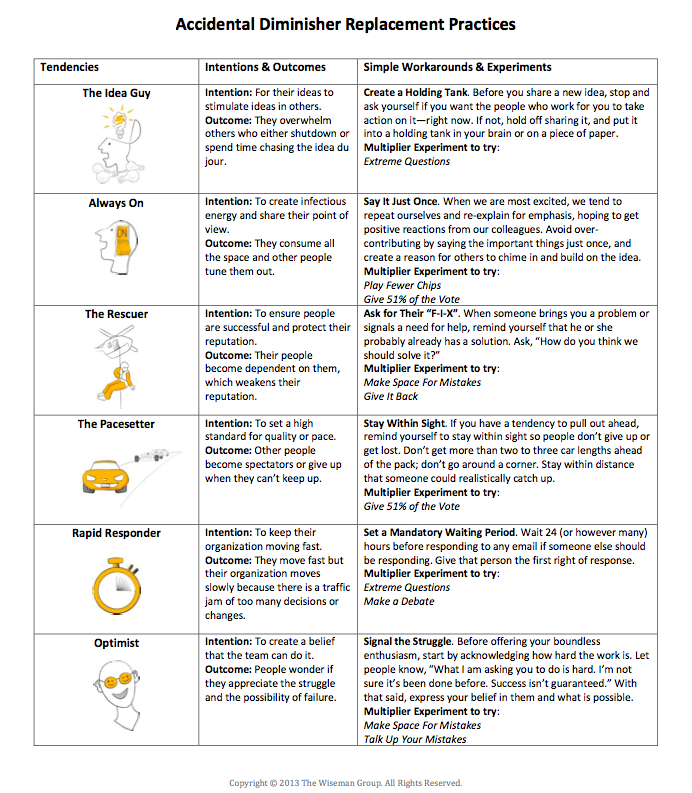
So here is the chart distinguishing the difference between diminishers and multipliers...


Rookie Smarts...
She explains that those who are rookies at something actually can outperform others in innovation work because they ask better questions and don't assume to know everything. They also better gather and connect pieces others are aware of, due to passion for the challenge. So often we are at the best, when we know the very least.

When we step out of a place of knowing into a place of not knowing...we actually can better see God's hand and see light and personal direction more clearly. It is scary, but so invigorating at the same time. The fire of faith can burn more brightly. Faith is power. And it takes faith to step into the unknown and abandon old habits, practices, plateaus, etc. We don't see clearly until we unite our knowledge and our faith. The state of not knowing can be a path to better know God. We are so often at our best when we don't know because we better rely on God's knowledge to lead and guide us to our optimal happiness and satisfaction in life.

4 Ways to Live Powerfully in the Realm of Not Knowing
1. Ask Intelligent Questions. Start operating from a place of inquiry, rather than a place you feel you know everything about. Ask questions to drive recall of what others know...rather than making command and stifling knowledge-growth. Tell less, ask more.
2. Admit What You Don't Know. Holding back is a path of fear and also covers potential opportunities for growth, individually or as a team.
3. Throw Away Your Notes. If we really know something we won't need to have the notes. It's important to have fresh thinking, once you've gotten to a depth of knowledge in something.
4. Learn to See Genius in Others The top of the intelligence hierarchy is not the one with genius, but the one who is a genius-maker of others and helps others feel great and intelligent. Genius makers are the best learners and also perpetual rookies. And its the know-how they build, not the know-how they bring.

It's in seeking, not knowing, that we really find truth and discover God's true glory and intelligence. Seek wisdom  and intelligence--not knowledge in and of itself.

So what do you know?
Could you be in a plateau that is holding you back from reaching your potential?

And what is an area that you feel drawn to, but that you feel like a rookie in?
And is there an opportunity to take a challenge and more clearly see youth path and find God more deeply in your life and heart?

March 22, 2016

Motherhood Parables: The Highchair Stare

So I was feeding my little 16 month old last night and trying to figure out what in the heck she wanted.

You know those times you hear unintelligible noises coming from the corner of the kitchen and you think, "what? I'm sorry...Are you trying to ask for more food?" (while I'm cleaning the dishes and vaguely aware of your existence) :P

Sometimes it can get kind of annoying to figure out those cues from baby. But other times is so cute and can be viewed as a powerful, bonding experience.

So this time (thank goodness it was a good day and my patience-levels hadn't reached "burnout" yet), I enjoyed the chance to just slow down and stare at her. And she stared back---though she was not staring at me, but at one of the two things in my hand.

I had picked up water in one hand and a banana in the other.
She briefly glanced at the water, and then at the banana--at which she continued to stare.
I knew she wanted the banana.

How did I know? Well, that's what she was intently focused on. So...I gave her the banana. And a smile crossed her face. Obviously satisfied with both the object she received, and the acknowledgement on my part of her request--the smile of satisfaction from knowing she was heard and understood.

---
Ahh...to feel heard and understood--valued. And to really feel the deep satisfaction of receiving something you truly want or need.

I'm not talking about getting a birthday present from someone that means nothing and that you probably send to the thrift store. I'm talking about a more lasting satisfaction of a deeper yearning and need. The need to feel you are expressing the depth of what your heart feels and aches for (whether or not you fully are aware of that yourself). The need to feel you are of worth and your life is amazing, despite the temporary messy house and chaos that happens daily.

---
Wow...I could go on and on, but I think this is where this parable stops for today. But, to summarize two points:

  • Paying attention to where our focus is (or isn't) is a great clue to what we truly need or want. We may quickly glance from one thing to the next, but it is where our constant focus keeps pulling us back to that is a clue to where our attention really lies (for better or worse). And if for worse, we can change and dig deeper to find a greater, deeper need and desire.
  • Receiving what we truly, righteously desire is so soul-satisfying that it's satisfaction has a tremendous power to change both giver and receiver immensely (even immediately). And that power's sustaining effect can help us better deal with temporary chaos and open the door to new perspectives on our situations that allow greater relationships and awareness for things that really matter.
And really it all boils back to the atonement and our Divine NAture. We are divine being of great potential that gets hidden or bombarded in this life. We have it. Some know it, but others don't. As we seek to be our truest self and understand that divine potential, God opens doors and shows us who we are and how we can best be of use to our fellowman to fulfill their deep needs. And the end result is that our deepest need too are filled and we shine bright and are infused with Joy that lasts beyond the daily "vales of sorrow" we encounter in this life.


-------------- Two great C.S. Lewis Quotes---------------

“It would seem that Our Lord finds our desires not too strong, but too weak. We are half-hearted creatures, fooling about with drink and sex and ambition when infinite joy is offered us, like an ignorant child who wants to go on making mud pies in a slum because he cannot imagine what is meant by the offer of a holiday at the sea. We are far too easily pleased.” 

“It is a serious thing to live in a society of possible gods and goddesses, to remember that the dullest most uninteresting person you can talk to may one day be a creature which,if you saw it now, you would be strongly tempted to worship, or else a horror and a corruption such as you now meet, if at all, only in a nightmare. All day long we are, in some degree helping each other to one or the other of these destinations. It is in the light of these overwhelming possibilities, it is with the awe and the circumspection proper to them, that we should conduct all of our dealings with one another, all friendships, all loves, all play, all politics. There are no ordinary people. You have never talked to a mere mortal. Nations, cultures, arts, civilizations - these are mortal, and their life is to ours as the life of a gnat. But it is immortals whom we joke with, work with, marry, snub, and exploit - immortal horrors or everlasting splendors.” 
― C.S. LewisThe Weight of Glory

March 15, 2016

7 Habits of Highly Effective People

Stephen Covey was a great man. He frequently was pouring over books in all subjects, from quantum physics, to poetry, to nature, to art, etc. HE was a renaissance man. And because of his through searching and love to truth and knowledge from various sources and subject, he was able to glimpse patterns and see parallels and principles that many took for granted, or weren't clearly aware of because of their limited view or exposure.

Covey did his best to capture that information and convey it in a simple, clear, universal way for others to understand and implement. And from that he created a lasting work of greatness and a valuable tool for millions of people: The Seven Habits.

Now, you can go read a copy of the book if you'd like, but might I suggest reading the teenager version! It's very much more entertaining and easy to see applied. More pictures, less words. My kind of book. :)

But what I love about the principles is that it is the natural process of starting internally and moving outward. you can't give of self if self hasn't been nourished first. So his first three principles are working on a personal/internal level. Then the next three principles are moving outward/externally. And the last if the renewal of self by sharpening your saw, which allows a renewal of self and greater fulfillment of our true potential. Without that last habit, we stay in a rut at the same level and don't progress and improve.


I will try to post on each of these principles with a summary and some helpful visuals that help make them practical and applicable. But, here's another version of kids stuff being more awesome than adult boring versions.... Teaching kids simply is beautiful. Why can't we keep that beauty as adults--in other words, I prefer this tree visual!


Also, Covey wrote about an 8th habit too...which I think is great!

The book is called The 8th Habit: From Effectiveness to Greatness
Find your voice and inspire others to find theirs
The eighth habit is "Find your voice and inspire others to find theirs." Voice is Covey's code for "unique personal significance." Those who inspire others to find theirs are the leaders needed now and for the future, according to Covey.

(But I think it fitting that this eighth habit isn't in the initial seven. One has to become familiar with all seven habits first until they become a part of them. Once these principles come easily, then it's much easier to have balance and know how to use prioritize and use time and energy for others on a regular basis without overtaxing self. That's hard to do well if one is still struggling with basics and can't even maintain general effectiveness, let alone improve/"sharpen one's own saw.")


--
Side note...I'm including this thought about Abundance (from Covey Wikipedia page)...because I find that having a positive abundance mentality can make all the difference in the world about how you view the world and your positive reference for goals. And if we approach life with an abundance mentality and these seven habits then it's much easier to see and reach our potential.

Abundance mentality

Covey coined the idea of abundance mentality or abundance mindset, a concept in which a person believes there are enough resources and successes to share with others. He contrasts it with the scarcity mindset (i.e., destructive and unnecessary competition), which is founded on the idea that, if someone else wins or is successful in a situation, that means you lose; not considering the possibility of all parties winning (in some way or another) in a given situation (seezero-sum game). Individuals with an abundance mentality reject the notion of zero-sum games and are able to celebrate the success of others rather than feel threatened by it.[5]
Since this book's publishing, a number of books appearing in the business press have discussed the idea.[6] Covey contends that the abundance mentality arises from having a high self-worth and security (see Habits 1, 2, and 3), and leads to the sharing of profits, recognition and responsibility.[7] Organizations may also apply an abundance mentality when doing business.[8]

7 Habits: Habit 3 - First Things First

Here's an intro to Stephen R. Covey's 3rd Habit of Highly Effective People. 
For introductino to all 7 habits, read the introduction post.

But first, a quick note...
Ever since my busy time in high school I've been a list-maker. OR at least I was...until about the time I got married. Now I don't consider myself a list-maker, but more of a minimalist, prioritizer.

Lists are valuable to see items and things to be done, or noted. But if we stop at just a list, then we still have chaos. It's just chaos named. Taken one step further the list can then be ordered by priority.

So how do we prioritize our tasks and things that call on our energy and time?
This is where Covey's 3rd Habit helps...


It's helpful to evaluate what is urgent and what is important and then weed away what isn't.
So when an event or task pops into your radar, the questions to ask are...

  1. Is it urgent
  2. Is it important (to what I value...in order of priority)


Now, some people don't need a lot of fun, so they won't have it in their important quadrant (things they value), but if its important to you, then throw it up there! If it isn't, then it don't. The categories are great because they allow you to tailor your activities to your needs. Once you do this long enough it's easier to judge your activities and events calling you all over the place without needing this exercise.

But, if you never take time to evaluate your needs by which are important or not, or which are urgent and not, then you will experience a lot more chaos than needed.

So how do you find out what is important and what isn't? Well, this is the physical creation stage of your tasks....so you need to back up into the mental stage of creation first. This involves some thoughtful, personal time to delve into what you really value--establishing your personal priorities.

Like earlier, if you value fun, then that is important to you and you need to plan to get some in, even if it's just a little. I know I value trying new things and breaking routine...but that sometimes gets cut in my busy-ness....so I have to make sure I try to get that in or I don't feel as light and happy as I generally like to be. I also know that I value a peaceful home...but that sometimes get nixed when I'm yelling at the kids because of urgent things that cause stress and make me lose sight of my important things. But...if I know I value and want a peaceful home, even in those times of emergency, I can say "ok, this isn't the norm, and that's ok temporarily--for this emergency--until I can calmly get back to what I value."


  • Quadrant one is great because it helps us manage what is needful. Yet if we spent 100% of our time on that quadrant, we'd lose focus. 
  • Quadrant two allows us to focus and stretch ourselves to more fully live and enjoy ourselves in important things that get cut because of urgency. If we think 80% management and 20% focus, then we can have a good balance.
  • Quadrant three could entail all those push notifications, texts, and facebook notices that call your attention loudly and right away, but aren't really your priority. They try to force their way into your focus--but actually detract from it. A good idea for these distractions is to minimize them. Turn off notifications you don't need or get email notifications instead of tweets, so you can order and read them at a specific time you've set aside later...which takes away their false urgency." 
  • Quadrant four is just a pure waste of time. If it isn't urgent and important (this is a blessing) because it's an easy clue as to what should be cut.


When I know who I am and what I stand for and value most, then it's easy to place events and stress in proper perspective. Try to spend the most time in quadrants 1 and 2. Knowing that occasionally 3 and 4 will creep in--hopefully temporarily. If so, notice them and then cut them as needed so they don't throw you off-balance.


*for more on Covey Habits...stay tuned.

March 14, 2016

Motherhood Parables: Backwards Underwear

Ok, I'm sure we've all been through it: the three year old who still cant always get her clothes on the right way. Seriously, I get it's a matter of time, but something is seriously lacking in the mental awareness, my little one. At least when it comes to underwear.

It's one thing to get shoes mixed up if you can't feel a difference of left versus right. But little girls underwear? There is obviously a small front and a bigger back. And when that small front in in the back...one word: plumber-bum! I'm sure that doesn't feel good.

So the other day I noticed her underwear backwards and asked her, "how does your underwear feel?" and she said "a little uncomfortable." So I told her to look down and the front. And she noticed there was no picture...which she knew meant it was on backwards. Aha moment for her!

Is it just total ignorance on behalf of my little girl? OR
Did I, as her mother, need to take time to instruct more thoroughly (to go beyond the instruction/word phase of "this is the front"--beyond the principle--to point out observations.
Sometimes in the frantic pace of life we all forget to check which way our underwear is turned...in theory at least. All all too often our awareness is lacking. At these times we need a guide to further instruct us by a gentle question, such as..."how does it feel?"

Sometimes we all need aha moments. Those precious moments of increased awareness allow us to choose to observe and then act/change. And often times those moments come when we have problems and things don't "feel right," or sometimes even when we come across new information, or valuable resources that cause us to stop and take a look at something more closely.

Life problems that arise, or unexpected changes that come, can be important aha moments-- opportunities for "tweaking" something that needs to be corrected.


So, back to the kids...
When underwear is on the right way, we can both see it's turned correctly and we can also feel comfy. But if we only teach our kids one part and ignore the other, then they don't become real problem solvers needed to really grasp truth and try it for themselves. They need to understand how they see and recognize truth. And a big part of that may be how they are introduced to new learning opportunities and experiences.

Two important parts to learning:
1. Facts and Knowledge
Bits and pieces that enter the mind.
2. Awareness/Feeling (of truth, light, peace--the Spiritual witness/Personal revelation)
Observations and feelings about things that enter the mind.
Does something feel right? Does it feel true? Is there goodness here? Light? Or does it feel uncomfortable, heavy, wrong or dark?

Yea, behold, I will tell you in your mind and in your heart, by the Holy Ghost, which shall come upon you and which shall dwell in your heart. 
This is the spirit of Revelation.   --D&C 8:2-3

I was chatting with some friends about how great it is to be able to be with our kids when they are first introduced to certain concepts or experiences. What a fun time to help our kids learn to navigate through certain things. But even more important...what a great opportunity to really value those times of "new introductions" as a chance to focus on the question: "how do you feel about that?" To really get a chance to have good discussions and spiritual depth to our learning and conversations---thus allowing learning to go more deeply and internally into our children in ways that strengthen and grow their testimonies of light, truth and the power of learning by the spirit.

Beauty
This is beauty! Beauty allows for the feeling of truth--a depth to learning that brings a love and passion for it and allows it to really live deeply in both heart and mind--therefore lasting memory.

Beauty is often seen and felt without words and instructions. As we surround our children by things of real, lasting beauty, we allow them the experience of feeling beauty and knowing it (regardless of knowing it intellectually). Then when children are ready for the intellectual details, they get them even more powerfully because they've already felt it and lived amid it!

Classics
Take for instance a child surrounded by classics: music, poetry, literature, art, etc. When they grow up, they will feel so use to that climate. They will feel at home with the classical melodies, poetic rhythm of words, even difficult words, and beautiful art. They will feel their beauty and goodness and not expect less, because they were surrounded by greatness.

Nature
Taken a step further: Surround a child in nature and allow them to feel the beauty of the earth and it's mysteries. They learn to become aware and develop observation and gratitude for it. They love it and remember it and soon feel the drive to learn more about they beauty they've received so fully.

The Home (as Heaven on Earth)
Taken even one step further: a home of love and peace where Christlike attributes of love, patience, faith, gentleness and gratitude abound...and there will be a haven of safety and security. Now...this is ideal. And I'd love a perfect, peace-filled home always. But I know there are frustrations--and it isn't 100% all the time. And yet, I still seek my ideal. Knowing when I fall short, that it's ok as long as I keep turning to the savior to ask for help and personal revelation on ways I can better provide that atmosphere in my home. He wants what's best for us and can help properly instruct us in the details and the feelings needed to get that result. It's up to our awareness of what contributes to that ideal and what takes away from it that needs our utmost attention and priority. Once that is set, it's easier to keep course-correcting as we go.

----
So much for a short parable about underwear!
But...I like to feel comfortable and not have worries that my underwear is on backwards. So stop and take a moment to check yours--by sight and feel--before you proceed. :P

Motherhood Parables: The Tortilla Chip

Ok, so cute...!

I was sitting with my son the other day  (5 years old, almost 6), eating some nachos or something. And here is the conversation that followed...

Ethan said,
"mom, this chip is kinda like a triangle. Sorta. Well, it's "ish."
(He said it all matter-of-factly, yet with a question, at the same time.)

I looked at him, smiled and said,
"Yeah, I guess it is. It's -ish."

Then he went on...
"We are kind of -ish too, huh?"

And I said...
"Yeah, that's true. We are ish. And that's ok, isn't it?"

And responded with a smile...
"Yep. It's ok being ish."

And we continued eating our nachos, as we smiled together--bite after bite of our "triangle-ish" chips.

----
We had read a great, simple book a few times in the last year, that I could tell played a part in his awareness of this "ish" principle.... It's called Ish, by Peter Reynolds.

It is about a little kid who got frustrated that he couldn't draw the flowers perfectly. But then found out his younger sibling treasured his artwork more than he could've imagined. And told him his art was ish, and beautiful. Once that boy felt valued for his contributions in the way he best could contribute, he felt empowered to do more. He felt valued and special. This acceptance and love allowed him to do more and express himself greater--and draw--as he felt inspired (rather than based just on a specific, perfect outcome or result--according to some outsiders perspective and view).

Such a valuable lesson for all kids (young and old). If kids don't learn this principle when they are young, it will be a lot harder to break them out of their perfectionism and self-imposed walls of non-self-expression later. It's important to build and encourage our kids in ways they can contribute, not focusing on what they can't or where they fall short. They need to be allowed space, time, and ways to learn and grow. And what we do and say to nurture that growth in themselves (or hinder that) can have far lasting impacts.

...
After our lunch I was able to briefly mention that we are ish and make poor choices that get sad consequences. But that Christ, because of his great life of good choices got the greatest consequence of all: eternal life (including his resurrected/perfect body back and living with God again). And we too, even if we feel imperfect or "ish" can trust that as we love the Savior and try our best...he views our "ish" as beautiful. Because our ish is us giving what we can--an he focuses on our potential.

Whether of not Ethan gets the details behind this eternal truth, at this point, isn't my main focus; Just that he knows Christ is ok with Ish, and so am I. And seeing Ethan happy to just try--how he can--and not be scared of "failure" to hit a specific standard or expectation (that is not of eternal consequence), is good for me.

There is way too much comparison in this world. So many expectations and standards that some begin to take higher priority than those standards that really matter--like a Christlike character.

There is also too much negative/fear in this world. Fear is the opposite of faith. Where fear is, faith cannot exist. And I choose a house of faith. As long as we have faith in Christ, we can move forward to reach our potential. And I'm happy with that, even though our steps and accomplishments may seem slower or more "ish" compared to others. Our ish will be the ish it needs to be and we will have joy in our "ish-journey," knowing we are taking steps that matter, towards our eternal potential.


February 10, 2016

Notes: Random Power of Music Facts

Why should music be an integral part of our journey in life, or part of our mortal education?
It is powerful! It has been shown to integrate so many parts of our brain and really sink deeply into our mind, heart and body (physically penetrating!).

Here are a bunch of random points about music that I find interesting...
  • the sing-song language used by mothers to communicate with their infants, relies on a variety of musical features to communicate basic emotional information. Using exaggerated melodies and rhythmic repetitions, mothers can attempt to communicate positive and negative feelings to their infants, and appraise infants' internal states by the way they respond. (from here)

Here is a short article on the power of music... (about Elena Mannes' book, "The Power of Music")

  • She says scientists have found that music stimulates more parts of the brain than any other human function. That's why she sees so much potential in music's power to change the brain and affect the way it works.
  • Mannes says the cries of babies just a few weeks old were found to contain some of the basic intervals common to Western music.
  • Daniel Bernard Roumain, a young cross-genre violinist who is known as DBR, thinks one reason music is so powerful is that sound actually penetrates our bodies: "You know when someone says that a piece of music 'touched me' or 'moved me,' it's very literal. The sound of my voice enters your ear canal and it's moving your eardrum. That's a very intimate act. I am very literally touching you, and when you speak to me, you are literally touching me. And then we extend that principle to the sound of a violin."
  • The conductor and pianist Daniel Barenboim believes that our early connection to sound is another reason for its power — one that in today's world we sometimes forget. He thinks that because we live in a very visual society we're more aware of what we see than what we hear. But he reminds us that the latest scientific evidence reveals that the ear, which we now know is active in the womb, has an advantage over the eye. He also says: "The ear has a head start over the eye, which doesn't see anything until it comes out. The eye is also something that one can control more fully. If you don't like the way I look, and you don't want to see me, you close your eyes and I disappear. But if you don't like my voice and you're in the same room, then you cannot shut your ears in a natural way. Sound literally penetrates the human body."
  • music has the potential to help people with neurological deficits. (example: "A stroke patient who has lost verbal function — those verbal functions may be stimulated by music")
  • infants prefer "consonant intervals, the smooth-sounding ones that sound nice to our Western ears in a chord, as opposed to a jarring combination of notes."

Left-Right Brain Balancing 101


Are you more left or right brained?


Did you know that the best learning isn't with one or the other, but the synergy of both? Whole learning requires this integration and when the brain is off-balance it actually makes full learning harder. But there are many ways to balance the left and right hemispheres of your brain.

First establish where your strengths and weaknesses are...


Being aware of the different parts of the brain and their functions is also helpful.


Here is a picture of the brain and the parts associated with the senses. As we work on areas involving the senses and get multiple senses and parts of the brain engaged we strengthen our brain and those associated senses of the body. We build greater awareness and synergy in mind and body.

So What can we do to strengthen our left and right brains to work together? Use multiple senses to cross all over the brain! mullti-sensory experiences are how we were born to learn. Not at a desk by a giver of facts. Our brains my be sponges, to some extent, but they weren't made to passively absorb. They were made to make connections and adapt and explore in three dimension! :)

Here are some activities we already do that we can try to get in a little more....
  • reading, writing and performing poetry
  • listening to classical music like Mozart or Bach
  • playing an instrument
  • creating art or observing good art (I read somewhere that William Turner paintings have a great effect on balancing the brain...but I can't find that source.)
  • exercise where we cross all the different planes:

great article: http://www.npr.org/2011/06/01/136859090/the-power-of-music-to-affect-the-brain

-------
side notes:

Here is a simple article about how focusing on improving motor-coordination and brain-balancing will improve writing faster than focusing on handwriting in and of itself.

And here is a short article about needing both left and right to be a good artist:

Also, Brain Gym is a specific approach that teaches how to exercise the brain so the left and right hemispheres are working together--synergy. If you want to learn more about that and specific activities you can do, you can read more about that post. (there are more and more approaches coming out, so don't feel limited to that one)

---
Here is a taste...
Brain Balancing Techniques
If both hemispheres of the brain are in balance or in 'sync', then a natural electromagnetic shield is put up by your brain for protection from negative influences.

Your non-dominant hand is the hand with which you DO NOT normally write. Your dominant hand is your primary writing hand.

The reason we are learning to use both hands here is to establish a cross-dominant brain process. Every time you use both hands at the same time, you help your brain to be more balanced, and as a result, you can achieve a higher level of focus for any endeavor you might choose. 

Any physical activity involving movements that cross the mid-line of the body can help your brain become more balanced. Here are just a few examples:
·           Cross-country skiing
·           Rollerblading
·           Walking with arms swinging in rhythm with the opposite feet
·           Bicycling
·           Hiking
·           Dancing

Below are some exercises you can try which will help you to balance your brain.

Lazy 8s: Use a large sheet of paper and markers or crayons. Starting at the middle of the paper, draw a horizontal 8 with your dominant hand. Then draw another one with your non-dominant hand. Finally, with a marker or crayon in each hand, simultaneously draw a lazy 8 with each hand.

X Marks the Spot: Draw a big X on a piece of paper and study it. It can remind you that both parts of your brain are connected and can send messages back and forth.

Double Doodles: Using both hands simultaneously, doodle as much as you like for 3 minutes on a clean sheet of paper. Don't forget to breathe! Use different colored markers or crayons.

Hookups: Cross one foot over the other and one wrist over the other. Put your palms together, bend your elbows, pull your crossed hands to your chest and take about 10 deliberate breaths. Stay in this position until you are feeling calm and centered. This is an especially good exercise to perform before a potentially stressful event.


Book Notes: What is Emotional Intelligence?

The ultimate goal of raising children should not be simply to have an obedient and compliant child. Most parents hope for much more for their children they want their children to be tomorrow and responsible people who contribute to society who have the strength to make their own choices in life who enjoy the accomplishments of their own talents, who enjoy life and the pleasures it can offer who have good relationships with friends and successful marriages and who themselves become good parents.

In my research I discovered love by itself wasn't enough channeling that carrying into some basic skills that parents practice. as if they were coaching their children in the area of the emotion was enough. The secret lay in how parents interacted with their children.
Emotionally intelligent children and people are better at shooting upset calming down their hearts faster and because of the superior performance in that part of their physiology that is involved in coming themselves they had fewer illnesses they were better at focused attention. They were better at understanding and had better friendships.
Ocean within this context motion coaching parents only set limits and miss behavior is no longer the major concern compliance obedience and responsibility comes from a sense of love and connectedness the children feel within their families in this way emotional interactions among nation for instilling values and raising moral people. Children behave according to Family standards because they understand with their hearts that is expected and that living right is off of belonging to the clan.The key to successful parenting is not found in complex series elaborate family room convoluted and affection for you demonstrated simply through empathy and understanding good parenting begins in your heart then continued on a moment to moment basis by engaging your children when feelings run high when you're sad angry or scared the heart of parenting is been there in a particular way when it really counts. 

In the last decade of scientists have found that even more than IQ your emotional awareness and ability to handle feelings determines your success and happiness in all walks of life including family relationships. Children learn most lessons about emotion from their parents it includes the ability to control impulses delay gratification motivate themselves read other people's social cues and cope with life's ups and downs.

Family life is our first school for emotional learning. Parents to teach their children strategies to deal with life's ups and downs are called emotion coaches they don't object to their children's displays of anger or sadness or fear nor do they ignore them instead they except negative emotion as a fact of life and they use emotional moments as opportunities for teaching their kids important life lessons and building closer relationships with them.

Parents who failed to teach kids emotional intelligence fall under three categories:
1. Dismissing parents who disregard ignore or trivialize children's negative emotions.
2. Disapproving parents who are critical of their children's displays of negative feelings and may reprimand or punish them for emotional expression.
3. Laissez-faire parents who excepts their children's emotions and empathize with them but failed to offer guidance or set limits on their children's behavior.

5 Steps of emotion coaching:
1. Become aware of child's emotion (emotion awareness)
2. Recognize the emotion as opportunity for intimacy and teaching (relationship opportunity)
3. Listen empathetically validating child's feelings (empathetic validation)
4. Help child find words to label emotion (name emotion)
5. Set limits while exploring strategies to solve the problem (strategic limits)
Extra Help for setting limits...

Set Behavior Tolerance Zones:
Green Zone = acceptable behavior that lifts and builds.
Yellow Zone = leeway both for learners (age-appropriate) and for hard times (unusual circumstances and stressors)
Red Zone = unacceptable behavior that can not be tolerated (can be destructive--physically, morally, etc.)

Set Consequences
Children should understand consequences are not bad in and of themselves. Good behavior will get happy consequences/rewards. Poor choices will unhappy consequences. Regardless of whether they are happy or sad, consequences must be three things: Consistent, Fair and Related.

Time-outs
When used correctly, children are briefly isolated from positive interactions. A Time-out can be an effective way to help childre...
1. stop their mis-behavior (stop action)
2. calm down (feel)
3. start again on a more positive note (think how to change: make it right)

Spanking
Short-term: the threat may stop mis-behavior immediately, but without discussion... putting off chances to teach the child self-control and problem-solving
Long-term: spanking may not work at all, but rather make the child feel angry and humiliated more often causing retaliation and denial.

Work Together to Find Solutions
Identify some options. kids under ten may need to focus on trying one at a time until they find one that works)
Try role playing and fantasy play. Little kids are better at acting their part through a character and feeling free to experiment their actions. You can try experimenting with a right and a wrong version to see which seems helpful or correct. 
Brainstorming Session. For our children, a regular brainstorming session should work. Remind the child that no idea is too silly, and just throw any ideas out on the table.
Recall the child's past experiences and victories. This will bring confidence and help them visualize trying something new.

Help Your Child Choose a Solution
Feel free to share your past experiences and feelings similar to your child's situation...sharing mistakes and decisions, etc. don't be afraid to let them make a choice you wouldn't. If things don't work out, she can learn and try something new. And you can guide them in analyzing why it didn't work out. Regardless of the outcome, be supportive and help the child develop a plan for the choice made.

-------
Many well-meaning parents dismiss children's fears and upset as though they didn't matter in these cases the child begins to except the adults estimation of the event and learns to doubt her own judgment. if adults constantly invalidate a child's emotional feelings, the child will begin to lose confidence in himself.

Taking children's emotions seriously requires empathy been listening skills and a willingness to see things from their perspective. It also takes a certain selflessness. (but when a parent is stressed or otherwise distracted a child's incessant and sometimes irrational demands can drive the parent wild).

Many parents are letting go of the strict authoritarian models which they were raised and living with the growing believe in the intrinsic goodness of children more parents now believes their role is to assist children to develop according to their own interests needs and desires.

Parents must show genuine respect for their children's feelings. They should not tell children what they ought to feel, because that simply makes children distrust trust their feelings. Kids' emotions do not disappear when parents say "don't feel that way." And while not all behavior is acceptable, all feelings and wishes are acceptable. therefore, parents should set limits on acts, but not emotions and desires. parent should honestly express their emotions, provided that it is directed at a specific problem and does not attack the child's personality or character.

As helpless as babies are they can learn from our response to their discomfort that emotion has a direction that it is possible to go from feelings of intense stress, anger and fear, to feelings of comfort and recovery. When babies get upset they lack any sense control. And without a guide to take them from distress to comfort they can't self-soothe; instead their negative emotional experience becomes a black hole of anxiety and fear.

The first step parents can take toward raising emotionally intelligent children is to understand their own style of dealing with emotion and how that affects their kids. 

Situations when Emotion coaching may not work...
1. When you are pressed for time
2. If you need to deal with a serious mis-behavior
3. If your child is faking an emotion to manipulate you
4. When you are too tired or upset to be productive
5. When you have an audience


January 22, 2016

Motherhood Parables: The Walk-in Closet

Here's number three of my Motherhood Parable Series:

The Parable of the Walk-in Closet
I always wanted a walk-in closet! When we first got married we lived in an apartment. Two different apartments, actually. The closets were so tiny, I thought them a joke. (Really, they were standard small room closets, just not a walk-in). And I loved clothes! I had a bunch and I love wearing different layers and types of clothes to match the seasons. >I< NEEDED my walk-in closet.

Well, it wasn't until we bought our new house that I got my walk-in closet. It wasn't a big closet, but the fact you could step in, turn around and go back out made it it a walk-in. I thought, "This is ok, it's close enough."  But it wasn't the walk-in closet I really wanted! In fact, I still had two boxes of clothes in storage and a huge sweater box/trunk at the end of our queen bed.

Anyway, as dreams of a big walk-in closet with tons of shelves and places of all sorts of knick-knacks and such ran through my head, I started feeling like I had too many clothes. My problem was that I just kept accumpulating thrift-store clothes and donations and rarely got rid of them. I would "make do and wear them out" and then get rid of them. That is a good practice, in theory. However, I realized that I didn't wear most of the clothes, and that they were more of a burden to me in having to deicide what to wear and how to match things, than a blessing.

So, I started getting rid of anything that I felt was just "blah."
Then I got rid of anything Paul hated.
Then I got rid of things that I just had since high school that made me feel like a little kid, instead of the mother of three that I am.
Then I started going through things that looked worn, old, etc.
Then I started paying attention to colors and styles. And I got rid of colors that washed me out. And styles that didn't flatter my body type or my personality.

Four trash bags later I narrowed my stuff down to one trash bag full of clothes. About three shirts in each color, and six in the neutrals. About 6 skirts/dresses. About 8 shoes. A box of layering tees in the colors I love that coordinate with the colors of shirts I liked. I now had a basic color palette in my closet which made mix-n-matching much easier. And my closet soon wasn't looking so full.

Not only the closet, but the closet result overflowed into narrowing my jewerly and accessories down. I got rid of my jewelry box and just kept those things that were meaningful and matched my specific color pallet.

I still honestly. feel like I have too much stuff. Too many clothes. Too many shoes. Too many necklaces. And so on.... But I have come a long way. And you know what? I never even think about a bigger walk-in Closet now. I just bought a few closet organizer boxes for simple keeping of my specific clothing articles. A shelf for workout clothes. Box for socks. Box for underwear, etc. We even got rid of our night stands and dresser! And everything fits in our closet perfectly. And we have just one box for seasonal clothes that we keep at the top.

In fact, I even got rid of my lime colored shoes that I liked. Just because I'd bought them right after my mission and thought it was my spark of uniqueness back then. But I don't need that anymore. And I don't want to feel like a teenager, or in that stage of life. I've moved on to a new phase. It's so delightfully freeing!


Lessons Learned:

  • Our clothes make a statement. And since finding purpose and meaning in how I dress myself, I feel more purposeful and intentional in creating the life I desire.
  • I had too much stuff! It's easy to accumulate, but takes work to let go. Am I willing to think through those things?
  • "Wear it out and make do" works, if you are using it and like it. But if not...give it to someone who will use it more than you!
  • Better understanding my personality and what I like and want helps me choose and stick to a set look and feel that make me happy, instead of just wearing whatever is around, or trying to match other's styles or personalities. and it makes picking out clothes and shopping a breeze! More mental energy for the other things I really need to focus on.
  • More or bigger isn't always better. I frequently don't need more. I simply need to evaluate what I have and align it with what I want. The leftovers need to disappear. This creates not more stuff and greater organization. But rather, less stuff that is high quality and more meaningful and simplifying in it's effects.


So...what stuff do you just keep because it's around and you already paid for it?
Is the motivation of holding things a fear of letting go?
Are you too emotionally connected to the past and items that are holding you back in your maturing and moving into whatever season of life you are currently in?
Could you picture things you own on someone else, instead of you?


Motherhood Parables: The Messy High Chair

Here is the second parable from motherhood that has come to mind frequently...namely everytime I clean the high chair (daily).

The Parable of the Messy High Chair
We have a one year old baby. And boy does she love throwing food and squishing food all over her high chair and floor. I'm always surprised at how food gets in the most-inconvenient-to-clean corners of that chair. And I'm also surprised at the amazing sticking power sweet potato and other foods have. once dried. Some I would compare to the power of super glue! Seriously...not fun. Anyone who saw our high chair when baby first started eating would've thought I never cleaned it.

I wipe things down quickly if I get a chance. But frequently I don't get it all before it hardens. So Some would just pile on and I'd have crusty mountains piling up on the sides betweent he bars. Don't judge me as being a bad mom because of my messes! :)

Anyway, the first few months I didn't want to clean that high chair because it always involved a half hour of scraping and strenuous work. I used a pastry scraper. IT wasn't fun trying to scratch and force all those pieces of hardened gunk off...and especially in the corners.

IT wasn't until I stopped and actually thought about my approach and wondered. "Is this the best approach? Then I thought about my washing dishes. If a dish was left on the oven and the food remnants hardened in the pot, I always tell Paul to soak it over night and then I'll wash it in the morning. I'd rather spend two minutes washing it the next day, than Paul's 30 minutes trying to scrub it out late that night.

Isn't it the same with the high chair?
So I sprayed it with lemon water and went back ten minutes later with my rag and got most of it accomplished just fine, without a scraper.

Lessons learned: 
I am not the best cleaner.
I don't like cleaning things when I don't know how to do it well and it takes a ton of my effort, time, and energy.
Lemon water and a good soak is often times what crusty old dried food needs to get clean.
And I should just clean it up before it dries--but that's the ideal and honestly...not gonna happen as often as I'd like.

I think about this all the time in lmy life. What are my approaches to the things I do?
I especially think about it a lot with homeschool. Are things easier or harder than they should be?
What feels natural and nice and what feels forced and hard to do?

So, I will keep this question in my mind. And every time I see my high chair. :)

Motherhood Parables: The Wood Floor

There are so many lessons to draw from simple daily experiences that I decided to start a mini-series called "Motherhood Parables." There are two in particular that I think about a lot. One experience is about our new wood floor.

The Parable of the Wood Floor
This is s story about two people and a common floor--and the transformation that resulted.

Take Me, Shelley: I grew up shopping at thrift stores, garage sales, dollar stores...you get the point. I loved getting a good deal! I loved having tons of variety and exploring various styles, etc. My Dad would go garage sale-ing all the time and come back with the results  of "a good deal" all the time. It's what we did and how we stayed within our budget and lived "simply."

Then there's Paul: We aren't opposites exactly, but he definitely didn't grew up the same way. I don't even think he stepped into a thrift store unless he needed a costume for an event. And he certainly didn't like the dollar store and would frequently ask me why I bought "cheap junk " from there that is just going to break.

Now saving money and finding deals is a good way to go. It's especially great for if we have kids and they are just going to trash their clothes anyway. Might as well not spend $20 on something that will only last a month or two before they ruin it. But, does buying junk get our children use to being ok treating things like junk? A question I've never pondered until we were surrounded by junk and by kids' careless habits. Were they just kids? Or was this a habit learned from my shopping tendencies? Hmm...question to ponder.

So...imagine us moving into a nice new home. It was a quick-move-in home--which means that the builders had picked out all the interior details and such. Which was nice for us, because we didn't know what we wanted, and were just fine with the espresso-colored cabinets and silver fixtures. However, after years of living in it, our tastes have started to change--to develop.

Last summer I kept staring at our junky linoleum  kitchen floor and cheapest possible carpet. So cheap you can practically see through it and all sorts of surprises get caught down in it. I never really minded before, because I thought, "We have kids, it's perfect for now." But as I stared and stared, I wondered, "Why? Why do we have these things I actually don't like?" The answer was easy--"That's just the way is came. It was what I was used to."

As I thought about that I imagined what type of floor I wanted to have. And I saw a beautiful wood floor. As I pictured it, I felt uplifted and refreshed. I felt more beauty and joy. So I posed the question to Paul. He thought and thought. Then we shopped around a little just to amuse ourselves. But we thought, "We don't need a new floor. That's silly. Let's make do with what we have."

"Let's Make Do with what we have." --That's another parable I'll expound on.

But for now, I realized that there was some reason I couldn't explain of why I needed a new wood floor that cost money and was an inconvenience to put in. We were able to use our stove for a week and also have to move the fridge and dishwasher. It was hard. But it gave up new opportunities to think about the things we do daily without thinking about it. So we went ahead with the new wood floor. For some reason it just made sense to both of us from somewhere outside our logical minds.

With no oven, I was able to spend a week thinking about how to eat without one. We used a Thermal Cooker and a portable gas stove and I learned some emergency preparedness tactics. Cool! I normally wouldn't have self-imposed that experience on myself. But this was an opportunity.

We never use the dishwasher anyway, so I thought. Wow. I like having this space empty for my step-stool and recycle bin. Let's just get rid of this. Convention says everyone has one, but we don't use it...so why have it. Now that's gone.

The fridge...it was a pain to move, but was doable and there really is nothing special about that. So on we go with the story.

We decided on an orange bamboo floor that was on sale. Paul got a few tools for laying wood floor, And after a few weeks. Voila. In was the floor. (To this day we still haven't finished the edges) But the floor is amazing. IT transformed our home. The feeling is totally different! Our kitchen linoleum and great room carpet made the area feel like two different rooms. Now the space is extremely open. The color just contrasts and complements the espresso cabinets and beige walls so perfectly balanced, with a general warmth that exudes over the whole area.

I thought to myself, "How did we go so long without this amazing piece that creates such a strong change in our home?" And the answer..."We didn't know any better. We hadn't thought of it before. We weren't used to or experienced with wood floors. It just never occurred to us--the potential."

Now I'm not saying everyone needs a wood floor. It's like a haircut. Different cuts for different face shapes and blah, blah blah. But...we finally have something that fits us, our personality, our home atmosphere we are going for. And when those all align--wow. There is true harmony.

Now, i have to tell you. I'm a horrible deep cleaner most of the time. Paul will readily admit that he deep cleans our bathrooms. I, on the other hand, would rather organize and find a home for everything in the house. I know exactly where everything is. But Paul always notices when things aren't clean. We just have different focuses. I tidy up. He cleans.

So with the new wood floor, it requires extra care. Such quality needs to be well-maintained. Paul questioned how I was going to keep it clean, since I struggled keeping the linoleum clean. And the answer has been it isn't a problem. Why? I love my floor. I appreciate and value it so much--it brings me joy--that I can't help but want to take care of it and clean it. I realize the importance of not letting water sit on it too long or it will ruin it. So I take care of it. I have tools to take care of it, so it is easy for me. And we established rules for the kids so they too understand the importance of being gentle and careful with it.

The result?
Well, the transition was hard at first, for the kids. And we got some scratches from kids not thinking or not understanding the effect of certain toys being dragged accross, etc. But overall now, the kids get it. Ethan has to clean up his floor messes right away. We put felt pads under some furniture that could scratch. I sweep at least once a day--but I was doing that already. And the list goes on.

My Lesson: by having quality that fit our needs, desires and feel of our home. And by establishing rules and a foundation of appreciation and understanding the floor and reasons why we treated the floor well. We set expectations that our children rose up to. They aren't as reckless and have more awareness. They understand what good quality is. They appreciate nature and know where wood comes from and how certain things do and don't work with wood--so they better appreciate nature. And I understand better why I never liked cleaning--I didn't value the result or the materials. It was a task to do, instead of the results to be pleased with. I realize I have transformed. I love quality when it matters and am ok spending a little extra (though still on sale) if it will benefit and transform me and my family or our house to better reach our ideal and potential.

There are many other lessons and things I could go on about, but this is running much longer than expected. So if you read this whole thing. Give yourself a pat on the back. You made it through.
And hopefully there is something helpful for you in this.

 Life is about learning and transforming and getting better acquainted with our true potential. What is your true potential. How are you transforming? What new experiences and opportunities surround you?


January 11, 2016

Einstein Quotes

“I am enough of an artist to draw freely upon my imagination. Imagination is more important than knowledge. Knowledge is limited. Imagination encircles the world.” 

“If you can't explain it to a six year old, you don't understand it yourself.” 

“If you want your children to be intelligent, read them fairy tales. If you want them to be more intelligent, read them more fairy tales.” 

“Logic will get you from A to Z; imagination will get you everywhere.” 

“Anyone who has never made a mistake has never tried anything new.” 

“Try not to become a man of success. Rather become a man of value.” 

“A human being is a part of the whole called by us universe, a part limited in time and space. He experiences himself, his thoughts and feeling as something separated from the rest, a kind of optical delusion of his consciousness. This delusion is a kind of prison for us, restricting us to our personal desires and to affection for a few persons nearest to us. Our task must be to free ourselves from this prison by widening our circle of compassion to embrace all living creatures and the whole of nature in its beauty.” 

“Any fool can know. The point is to understand.” 

“If I were not a physicist, I would probably be a musician. I often think in music. I live my daydreams in music. I see my life in terms of music.” 

“The world as we have created it is a process of our thinking. It cannot be changed without changing our thinking.” 

“You never fail until you stop trying.” 

“The most beautiful experience we can have is the mysterious. It is the fundamental emotion that stands at the cradle of true art and true science.” 

“Look deep into nature, and then you will understand everything better.” 

“Reading, after a certain age, diverts the mind too much from its creative pursuits. Any man who reads too much and uses his own brain too little falls into lazy habits of thinking.” 

“Only a life lived for others is a life worthwhile.”